
5 Facts About Puccini’s La bohème
Explore some of our favorite facts about Puccini’a La bohème. This opera classic, premiering in 1896, has an enduring legacy both in and out of the opera genre. Take a look at some of our favorite surprising facts about the show before you see Remi Wörtmeyer’s world premiere of La bohème at the Davidson Theatre.
1. THE ERA OF REALISM
The opera La bohème follows an Italian operatic storytelling style that was popularized in the late 19th-century, Verismo. Verismo is the Italian word meaning “true” or “real.” Verismo Opera is characterized by a shift away from the mythical/historical storylines of the Romantic Era in preference for storylines about the struggles of ordinary people!
Key Identifiers of Verismo Opera:
- The tale is believable
- Characters and experiences feel familiar
- Stories often take place in the composer’s present time
Although Puccini did not invent Verismo Opera, his work, La bohème, is one of the most identifiable works to come out of the Verismo Opera era.
2. TWO LA BOHÈMES…?
The creation of La bohème took 3 years. That’s a long time. And while Puccini was creating his version, which was wrought with struggle and artistic disagreements, another was brewing. The composer Leoncavall (Pagliacci) was also working on his own version of the story based on Murger’s novella Scènes de la vie de bohème (Scenes of Bohemian Life). And Leoncavall even claimed that he had priority on the subject!
However, Puccini took it in stride and was quoted as saying “Let him compose. I will compose. The audience will decide.” And the audience did, in fact decide. While Puccini’s version of La bohème has endured as, arguably, one of the most well-known operas of all time, Leoncavall’s has all but disappeared.
3. YOU KNOW IT…EVEN IF YOU DON’T KNOW YOU DO!
Did you know that La bohème inspired one of Broadway’s most famous musicals? And odds are, even if you haven’t seen it, you’ve heard of it. This show premiered in 1996 and won the Tony for Best Musical, Best Original Score, and the Pulitzer Prize for Drama.
Drum roll please 🥁🥁🥁 Rent!
Many elements in Rent, such as the characters and plot points, from Puccini’s La bohème can be found in the musical. In the musical, the HIV/AIDS virus replaces tuberculosis. Additionally, you can hear nods to the opera in songs such as in ‘Light My Candle,’ which is a direct reference to how the main characters of the opera first meet and fall in love.
“I had this idea for a Bohème for now — for our generation that had sort of a ‘noise’ and [that] captured the un-Bohèmeness of it: not sweet and not luscious.”
– Billy Aronson
Although detached from the project early on, it was Billy Aronson who brought the idea to Jonathan Larson (the creator of Rent) — to re-envision the classic opera La Bohème and set it in the streets of contemporary New York City. (Source: Playbill).
4. A CINDERELLA STORY
To help celebrate the completion of the show, Puccini hosted his own masquerade ball. It took place in December 1895 only a few months before the World Premiere of the show in February of 1896.

5. FAKE FAN
One of the most memorable aspects of Pucinni’s La bohème is its setting: the streets of bohemian Paris. The ambiance of the Parisian street life is almost a character within itself, bringing a presence to the production that only adds to the story. However, although it is such a huge part of the opera, Puccini had never actually been to Paris when he wrote La bohème!

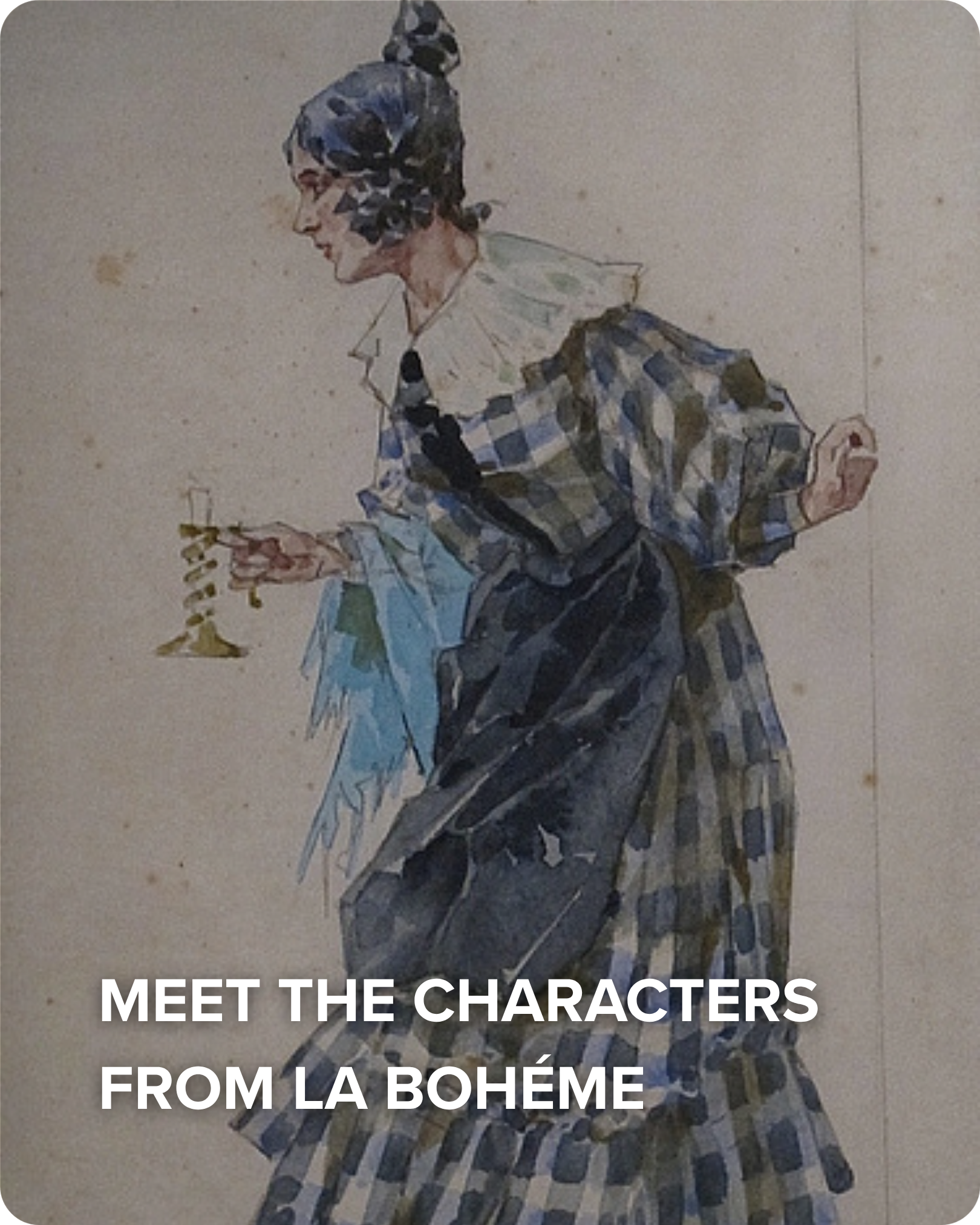
(Image Source: Metropolitan Opera)
Explore More:
 |
 |